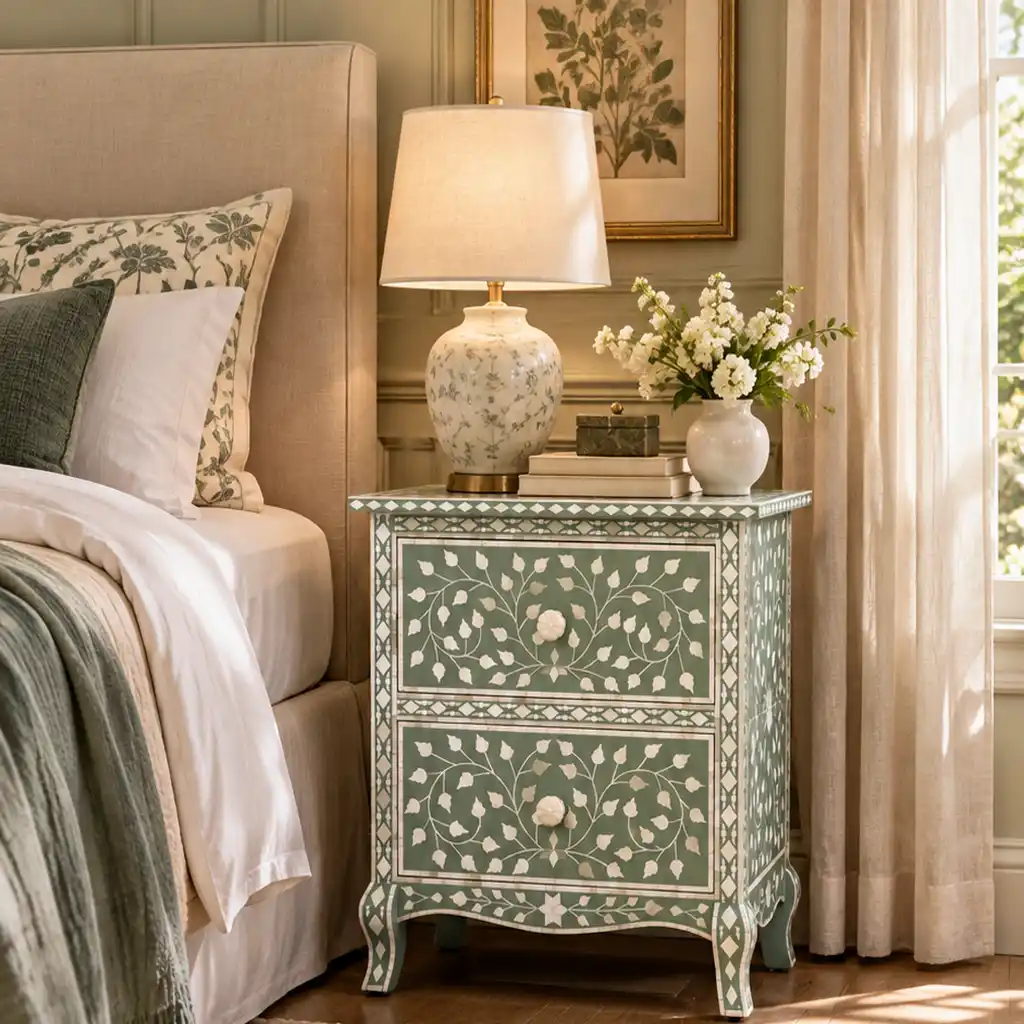
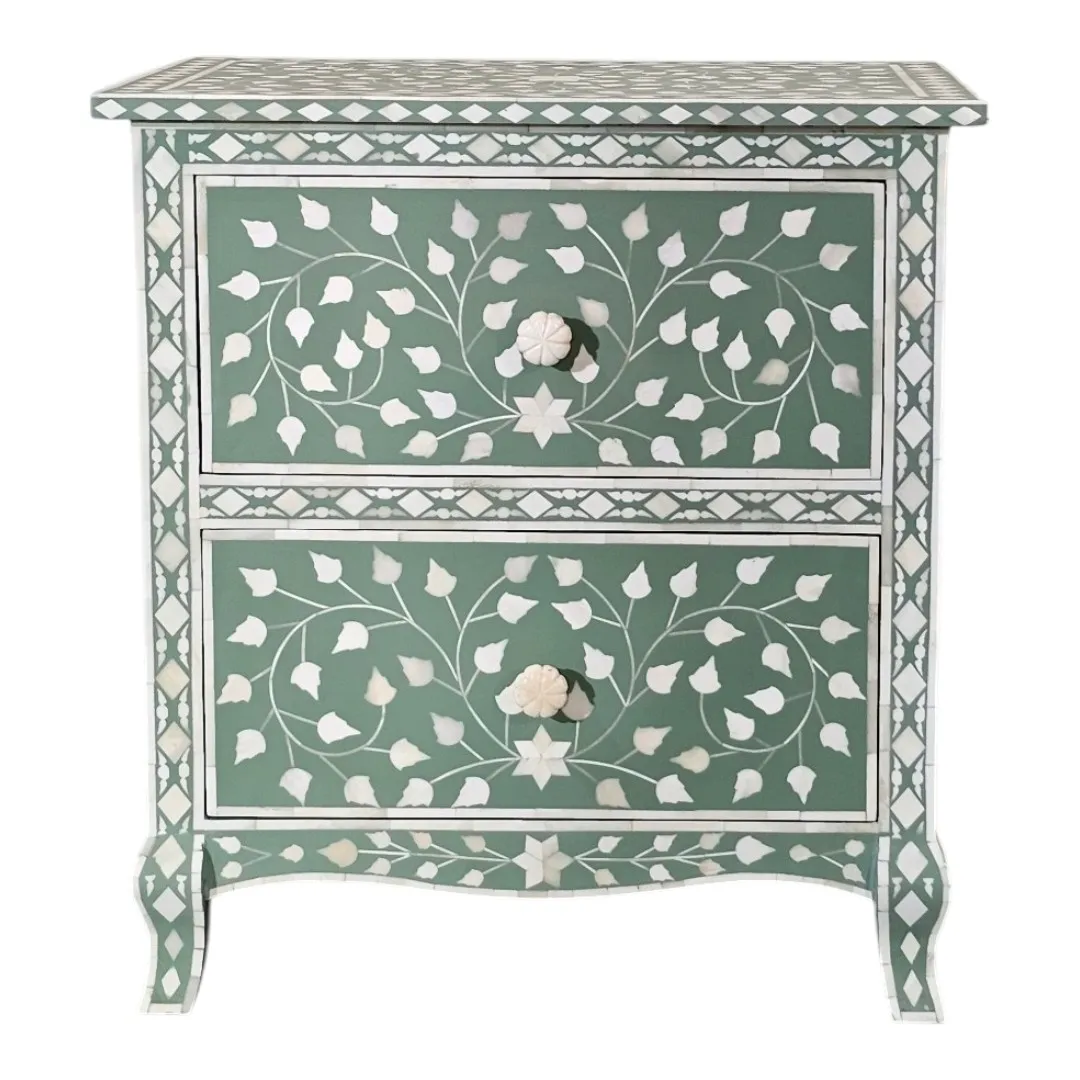
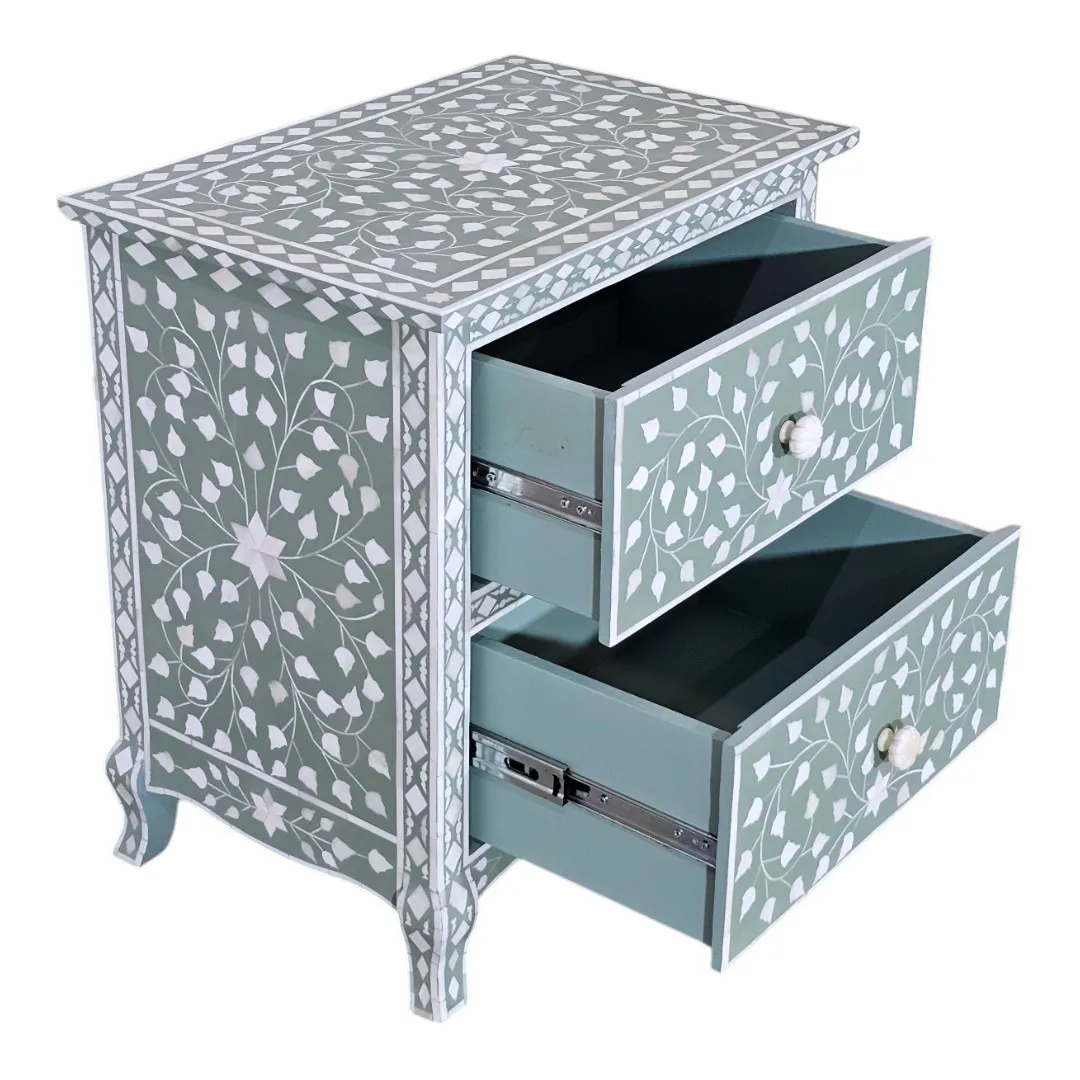
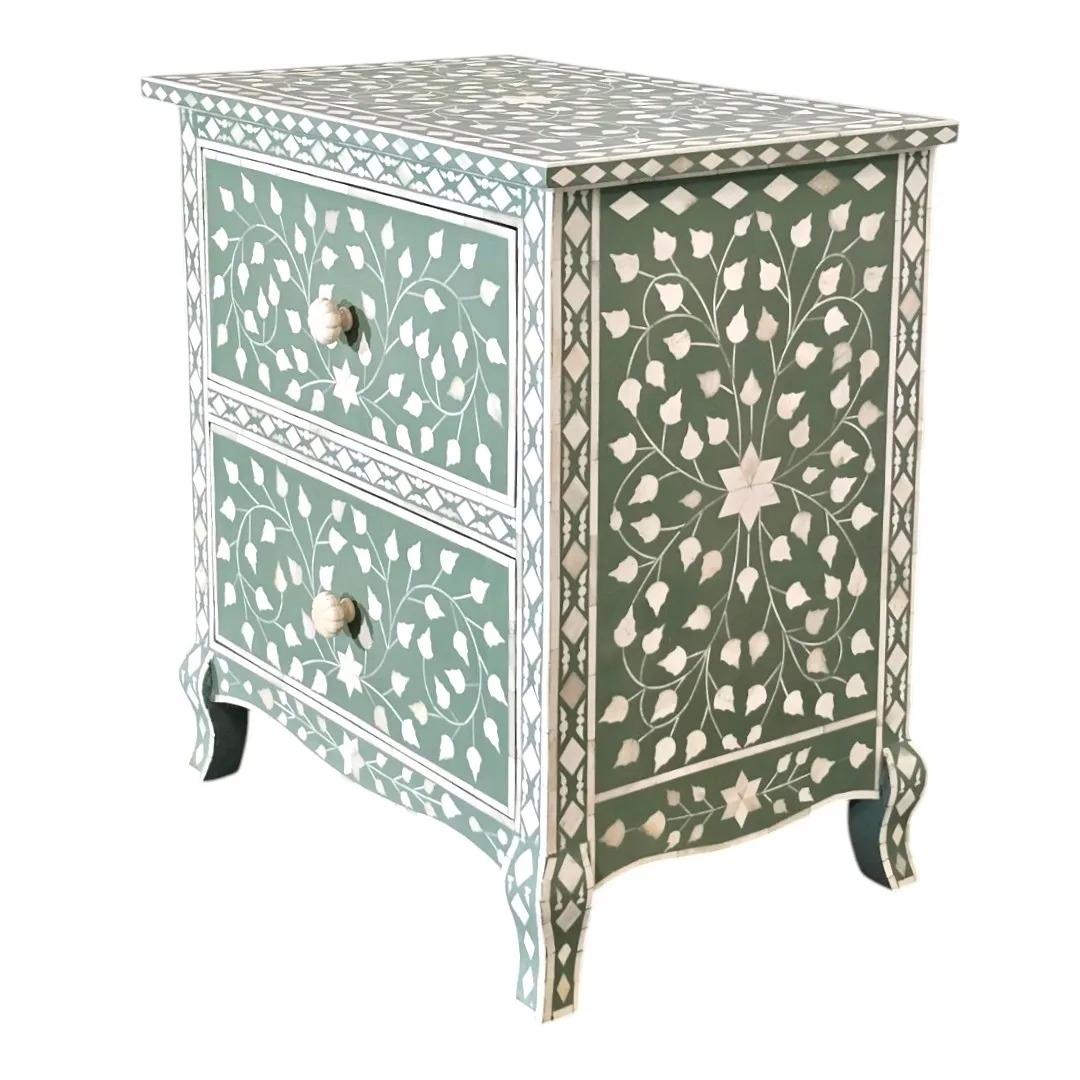
Named Jardin de Gulzar—a French-Persian compound translating to Garden of Rose-Blossoms—this bedside table draws inspiration from the cross-cultural trade between European courts and royal Indian workshops during the 17th and 18th centuries. Its sweeping serpentine profile and cabriole legs pay homage to classical French commode arbalète silhouettes, while its surface artwork honors the imperial rose gardens (Gulshan) of Mughal courtly architecture.
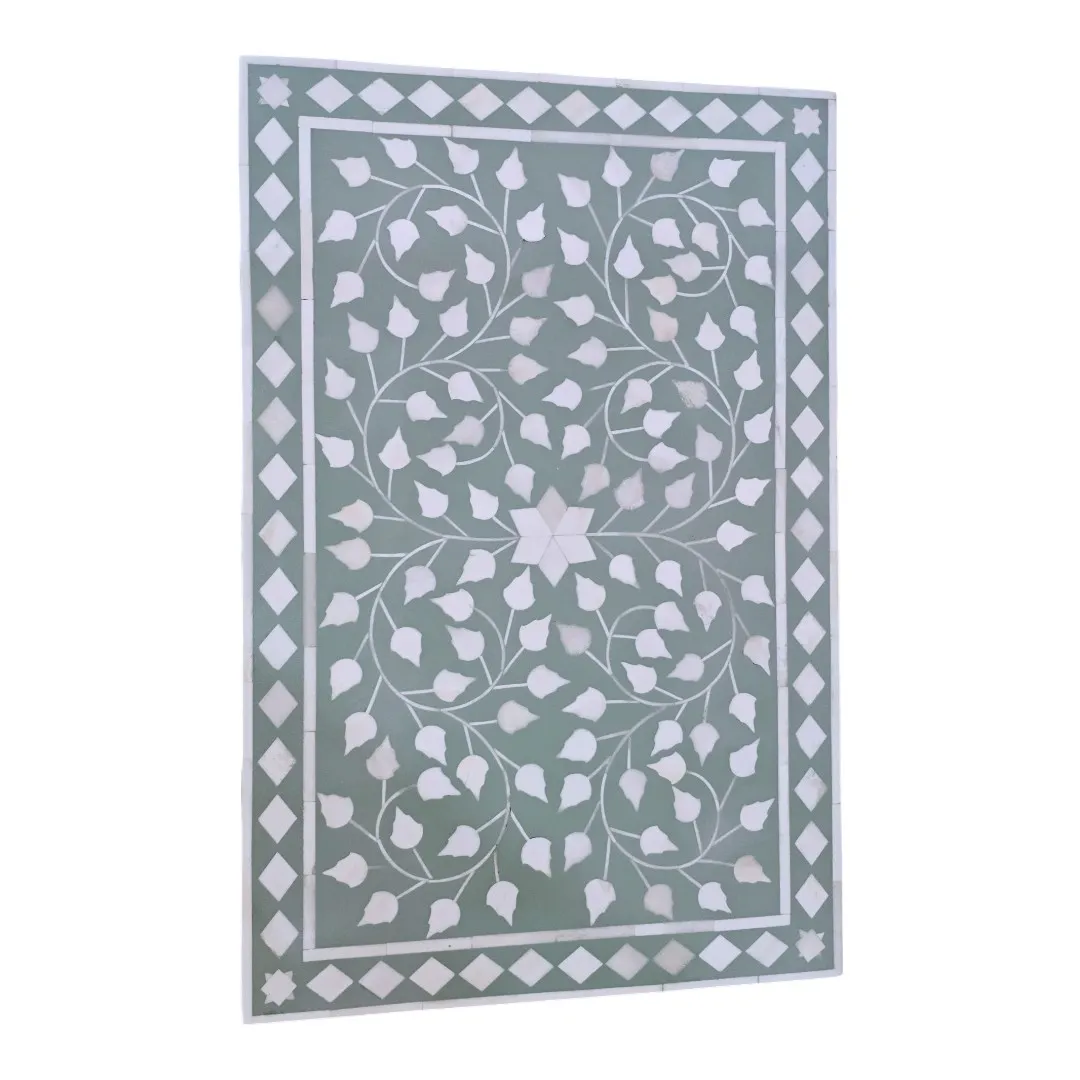
The repeating tear-drop rose foliage pattern (Gul-Butti) stems from a central six-pointed star medallion, symbolizing renewal, eternal growth, and cosmic balance. In Indian decorative arts, the rose plant holds a sacred historical position, popularized during the reign of Emperor Jahangir and Empress Nur Jahan, who cultivated rose gardens across Kashmir and Agra. This motif appears in the marble pietra dura stonework and fresco cartouches of iconic heritage sites, such as the City Palace of Udaipur, the Amber Fort in Jaipur, and the Taj Mahal complex.
Creating this piece requires over 100 hours of painstaking artisan labor. Master craftspeople in Rajasthan manually saw ethically sourced bone into delicate leaf shapes, carve matching recesses into the wood composite substrate, and manually embed each fragment. A custom sage green mineral resin is poured over the surface, cured, and hand-sanded across multiple stages using fine stone pastes until the bone and resin form a luminous, flat-buffed finish.
Constructed over a high-density wood composite core, the table offers exceptional structural permanence, resisting seasonal warping and joint movement. As an authentic handcrafted creation, subtle organic variations in bone shade ensure that no two pieces are identical, offering a one-of-a-kind statement that anchors modern residential spaces.
STYLE DETAILS
Architectural Influences: 18th-century French serpentine furniture and Mughal court garden pavilions.
Pattern Style: Trailing rose foliage scrollwork (Gul-Butti) framed by geometric diamond borders.
Decorative Elements: Hand-cut bone tiles, scalloped apron detailing, and carved bone rosette knobs.
CRAFTSMANSHIP DETAILS
Technique Used: Traditional Indian Nakashi Bone Inlay over an engineered wood composite core.
Skill Level Required: Master Artisan level, requiring generations of inherited craft mastery.
Distinguishing Handcrafted Features: Micro-variations in leaf cutouts, natural bone grain nuances, and hand-contoured joinery.
Finishing Process: Multi-stage stone hand-sanding, resin flooding, and protective clear satin sealing.
WOOD COMPOSITE FINISH CHARACTERISTICS
Type & Grain Richness: Smooth sage green mineral resin backdrop contrasted against creamy ivory bone.
Depth & Texture: Luminous, flat-polished tactile surface with subtle organic warmth under ambient light.
Difference from Mass-Produced: Assembled entirely by hand without printed patterns, synthetic veneers, or plastic components.
Longevity & Aging: Natural bone develops a subtle patina over decades while the engineered wood composite core ensures lasting structural stability.
WHY YOU’LL LOVE IT / INVESTMENT VALUE
Commands attention as a sculptural centerpiece in luxury master bedrooms and suites.
Deeply rooted in centuries of Rajasthani and French courtly design lineage.
Engineered wood composite core guarantees long-term durability.
Handcrafted exclusivity elevates functional storage into collectible artwork.
SUGGESTIONS FOR INCORPORATION
Placement Ideas: Master suite bedside table, executive study side table, or formal entry lounge accent.
Styling Tips: Style with an antiqued mirror, alabaster table lamps, and fine linen bedding.
Lifestyle Use: Holds daily bedside essentials and reading materials while functioning as a statement piece.
DETAILED SPECIFICATIONS
Color: Sage Green and Luminous Ivory Bone.
Finish: Smooth Hand-Polished Satin Seal.
Origin: India.
Age/Period Influence: Mughal Imperial Revival / French Serpentine.
PERFECT FOR
Room Placements: Master bedroom, guest suite, executive study, formal salon.
Functional Uses: Bedside table, storage nightstand, accent side table.
INTERIOR TYPES
Modern Luxury, Bohemian, Contemporary Transitional, Classic European, Eclectic.