
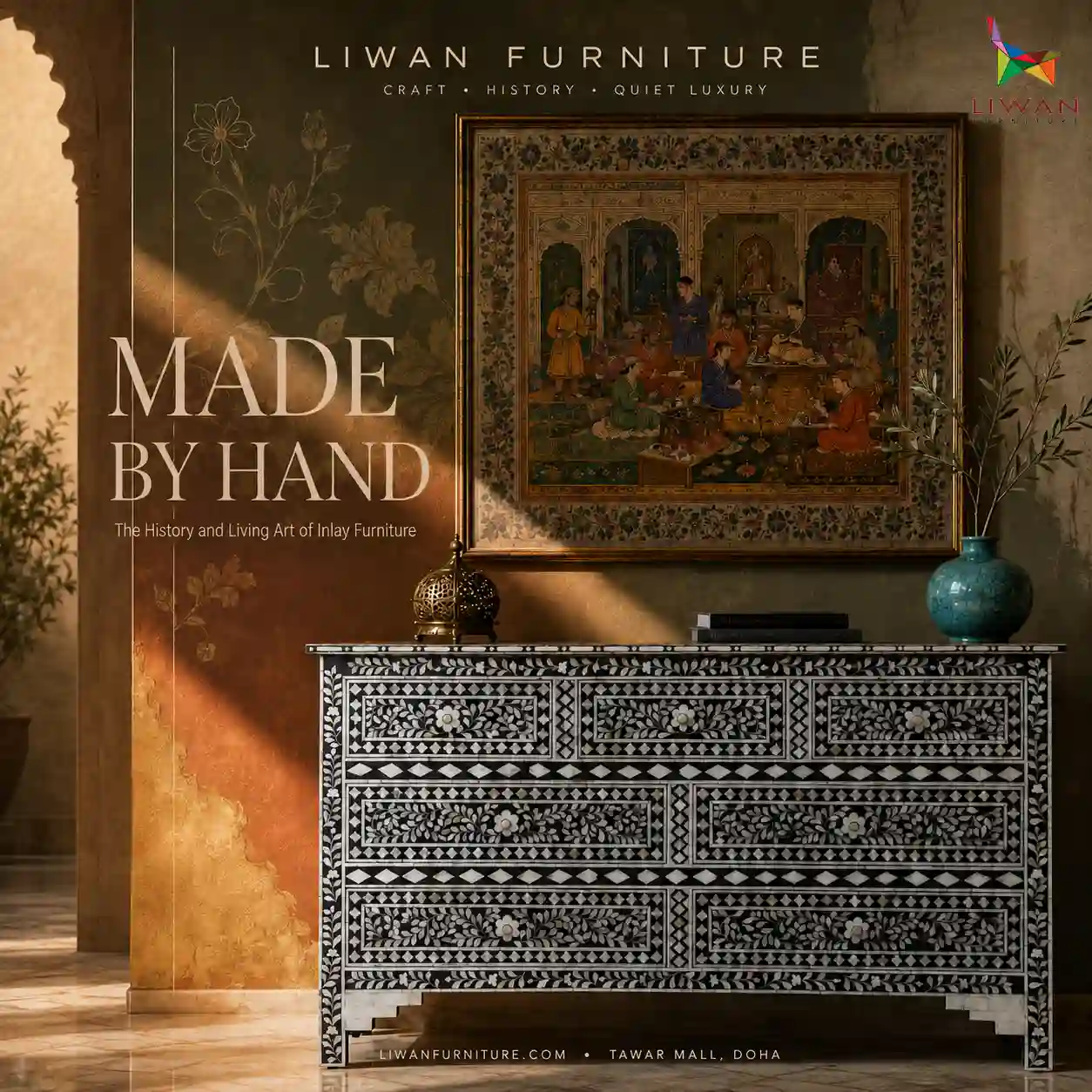
Long before furniture could be reproduced by machines, its value was measured by material, skill and time. A cabinet was not merely storage; it could be a record of trade, culture and the hand of its maker. Among the most remarkable expressions of this tradition is inlay—the patient art of setting individually shaped pieces of precious or contrasting material into a surface to create pattern, rhythm and light.
At Liwan Furniture, this history is not treated as something confined to museums. It remains a living source of design: carried forward through solid wood, mother-of-pearl, bone inlay and the knowledge of skilled artisans in India, then brought into contemporary homes and interior projects in Qatar.
A craft with roots across cultures
Inlay is not the invention of one place or one period. Variations appeared across ancient and later decorative traditions in Asia, the Middle East and Europe, using materials such as shell, wood, stone, metal, ivory and bone. Trade allowed both techniques and visual languages to travel, producing furniture that often combined local craftsmanship with forms desired by international patrons.
The history most closely connected to Liwan’s mother-of-pearl furniture is the celebrated luxury-furniture tradition of western India.
The Ashmolean Museum’s Jameel Centre records that, from the sixteenth century onward, Indian workshops produced luxury furniture that was European in form but Indian in its materials and decoration. Gujarat and Sind became important export centres for cabinets and caskets overlaid with iridescent mother-of-pearl. These objects travelled far beyond India and became part of an early international market for handcrafted luxury. Ashmolean Museum: Wood, ivory and mother-of-pearl
The Metropolitan Museum of Art similarly notes that Indian goods decorated with mother-of-pearl were collected in Europe and can still be found in royal treasuries and cathedral holdings. It places these works within the growth of maritime trade during the late sixteenth and early seventeenth centuries—evidence that Indian craftsmanship was already influencing global ideas of luxury hundreds of years ago. The Met: Mother-of-Pearl—A Tradition in Asian Lacquer
The Mughal period: a meeting of artistic languages
The great period of Mughal art, approximately 1580–1650, created another important setting for highly skilled decorative work. The Victoria and Albert Museum explains that Hindu and Muslim craftspeople from northern India worked alongside Iranian masters in royal workshops. Their different artistic traditions combined to form a new court style rich in floral imagery, geometry, symmetry and refined materials. V&A: The Arts of the Mughal Empire
The influence of this meeting can still be felt in contemporary Indian craft: repeating botanical forms, star-like geometry, ordered borders and patterns that balance intricacy with calm. Liwan’s collections do not reproduce historic court furniture literally. Instead, they allow this wider Indo-Persian design inheritance to converse with present-day consoles, sideboards, bedside tables, chests and cabinets.
Museum objects also show how sophisticated this work became. A seventeenth-century flower-form box attributed to India in The Met’s collection combines poplar, ebony and fine inlay in a complex piece of functional furniture. The British Museum preserves seventeenth-century Gujarati objects constructed with shaped mother-of-pearl plaques, brass and silver pins. These surviving pieces demonstrate that Indian inlay was never simply surface decoration; it depended on engineering, material understanding and extraordinary precision. The Met: Flower-Style Box with Drawers · British Museum: Gujarati mother-of-pearl ewers
From historic luxury to a living craft
Today, the form of the furniture has changed, but the essential rhythm of the work remains slow and human. A design must first be mapped to the proportions of the piece. Small sections of mother-of-pearl or bone are cut and shaped, positioned one by one, and surrounded by a contrasting ground. The surface then passes through stages of filling, levelling, sanding and polishing before the pattern becomes clear.
This process is the opposite of printed decoration. A printed motif sits on a surface; genuine inlay is physically assembled within it. Its beauty comes from material variation and the slight evidence of the hand. That is why two handcrafted pieces can follow the same design without being mechanically identical.
Mother-of-pearl: colour created by light
Mother-of-pearl is valued for its natural iridescence. It does not hold one fixed colour: its appearance changes with the viewing angle and the quality of light. Under soft daylight, it may read as silver or cream; in warmer evening light, flashes of pink, green and gold can emerge.
This shifting character explains why historic mother-of-pearl objects were prized across distant courts and markets. It also makes the material particularly relevant to contemporary Gulf interiors, where strong natural light, marble floors and evening hospitality create constantly changing reflections.
At Liwan, mother-of-pearl furniture is presented as a focal point rather than an object to be crowded by excessive decoration. Against a smooth coloured wall or within a calm architectural interior, the inlay can catch the light while the furniture remains elegant and functional.
Bone inlay: precision, contrast and pattern
Bone inlay offers a more graphic expression. The pale material can be cut into petals, stars, lines and repeating geometric forms, then set against natural wood or a coloured ground. The resulting contrast allows the design to be read clearly from across the room.
Its contemporary appeal lies in this balance: historical craft expressed through clean, useful furniture. A bone-inlay sideboard can bring enough pattern to define an otherwise minimal living room, dining area or entrance. One carefully chosen piece can give the whole space identity.
Solid wood is the foundation
Inlay may capture the eye, but the furniture beneath it determines how the piece lives. Liwan’s identity is grounded in handcrafted furniture, natural materials and the character of wood. Grain, tonal variation and small natural differences are not defects; they are part of what separates real material from artificial imitation.
The purpose is not decoration without function. A Liwan sideboard must still offer useful storage. A cabinet must open properly. A coffee table must work comfortably in everyday life. Craftsmanship has the greatest value when beauty and utility remain inseparable.
The materials used in Liwan’s inlay collections
Liwan’s inlay story is not limited to mother-of-pearl and bone. Across its collections, the decorative material is brought together with date-palm wood, teak, mango wood, brass and hand-painted tile. Each material has its own character and history, and each creates a different relationship between pattern and the furniture beneath it.
Material details vary from one design to another, so customers should check the specification of the individual piece. This variety is intentional: Liwan selects the wood and inlay method according to the structure, surface, colour and visual character required by the design.
Date-palm wood: a material connected to the Gulf
The date palm is inseparable from the cultural landscape of the Arabian Peninsula. UNESCO describes Al-Ahsa in eastern Saudi Arabia—home to approximately 2.5 million date palms—as an exceptional record of continuing human settlement and interaction with the desert environment. Historical Gulf building traditions also used palm elements because they were locally available; UNESCO research into traditional Bahraini construction records palm or mangrove wood used for structural lintels and sills. UNESCO: Al-Ahsa Oasis · UNESCO: Traditional Bahraini construction
Liwan’s use of date-palm wood brings this familiar regional material into contemporary furniture. Its strong linear fibres and irregular tonal variation create a tactile surface that feels earthy and architectural. Rather than concealing those natural marks, the design can use them as part of the decoration. This makes date-palm furniture especially meaningful in Qatar: it connects a modern interior with a material deeply associated with Gulf landscape, cultivation and daily life.
Teak: strength and a long furniture tradition
Teak has a long association with South and Southeast Asian architecture, shipbuilding and furniture. Its strength, stability and distinctive grain made it valuable wherever wood needed to combine beauty with practical endurance. Teak also became part of the historic exchange between Asian craft traditions and furniture forms made for international trade.
At Liwan, teak is used where the natural presence of solid wood should remain visible. It works particularly well for dining tables, seating, cabinets and substantial statement pieces. The grain provides warmth, while carved, brass, tile or contrasting inlay details can add rhythm without overwhelming the wood.
Mango wood: expressive grain and artisan versatility
Mango wood belongs to the material vocabulary of contemporary Indian furniture workshops. It offers visible grain, warm tonal movement and a surface that can be carved, sandblasted, stained, painted or combined with inlay. These qualities make it suitable for both clean modern forms and more decorative handcrafted pieces.
Liwan uses mango wood across furniture where variation is part of the appeal. Knots, changes in grain and subtle differences in colour are natural characteristics rather than flaws. In an inlaid sideboard or chest, mango wood can provide the structural body while mother-of-pearl, bone or metal creates the detailed surface pattern.
Brass inlay: light drawn in metal
Metal inlay has a substantial history across the Islamic world and South Asia. Historic objects demonstrate how brass, silver and copper were engraved, shaped and set into other metals or wood to create calligraphy, geometry and fine linear ornament. The British Museum, for example, preserves engraved brass objects inlaid with silver and copper, as well as wooden objects decorated with metal-stud inlay—evidence of the long relationship between metalwork and patterned surfaces. British Museum: Inlaid brass pen-box · British Museum: Wood and metal-inlaid knife
Liwan’s brass inlay translates that tradition into contemporary furniture. Thin lines or shaped pieces of brass catch the light differently from shell or bone: warmer, sharper and more architectural. Against dark timber, brass can define geometry; against natural wood, it creates a quieter glow. With time, the metal may develop a softer patina, adding character to the handmade surface.
Hand-painted tile inlay: furniture as a field of colour
Glazed and painted tiles have shaped architectural surfaces across Islamic lands for centuries. They brought durable colour, floral imagery, geometry and narrative scenes to walls, courtyards, religious buildings and private interiors. A nineteenth-century Qajar example at The Metropolitan Museum of Art shows the sophistication of polychrome painting beneath a transparent glaze, while The Met’s Islamic galleries include architectural elements decorated with glazed ceramic tiles dating back to the fourteenth century. The Met: Qajar painted tile · The Met: Galleries for the Art of the Arab Lands
In Liwan furniture, hand-painted tile inlay brings this architectural language to a smaller, functional scale. Individual painted tiles can be set into consoles, tables, cabinets or other wooden forms, allowing colour and the artisan’s brushwork to become part of the furniture. Unlike a digitally repeated print, hand painting carries small variations in line and tone. These differences give the finished piece its individual character.
Together, these materials allow Liwan to create several expressions of craft: the shimmer of mother-of-pearl, the graphic clarity of bone, the warmth of date-palm, teak and mango wood, the glow of brass, and the colour of hand-painted tile. The common element is the hand of the maker.
The Liwan connection: India to Qatar
Liwan Furniture brings together two places central to its identity. Its connection to India provides access to established craft knowledge, artisan production and the decorative traditions behind its inlay and carved-wood collections. Its presence in Qatar, including local carpentry support, keeps the furniture connected to the dimensions, practical requirements and hospitality culture of Gulf homes and projects.
This allows Liwan to offer more than imported objects. Depending on the design, clients can discuss customization in dimensions, colour, pattern or finish. The same capability can support private villas as well as cafés, restaurants, boutique hotels and other distinctive commercial interiors.
Liwan’s role is to respect the craft while presenting it through a contemporary architectural lens. Rich colour may be used, but the room remains considered. Styling may include art, books, ceramics or objects of hospitality, but the furniture remains the main character. The exact pattern, material, proportion and silhouette of each handcrafted piece must be seen clearly.
Why this furniture matters now
Mass production has made furniture faster and more uniform. It has also made objects easier to replace and forget. Handcrafted inlay furniture offers a different relationship with the home: fewer objects, chosen with greater care, each carrying visible material and human effort.
The historic pieces preserved by museums are evidence that Indian inlay furniture has crossed cultures and generations for centuries. Liwan continues that story—not by turning the home into a museum, but by giving living craft a useful place in contemporary Qatar.
When a mother-of-pearl surface changes in the evening light, or a bone-inlay pattern gives rhythm to a quiet room, the furniture does more than occupy space. It connects material, maker, history and home.
Explore Liwan’s inlay collection
The materials and techniques described in this article can be seen in Liwan’s current furniture collection. The following pieces show how heritage craft can take different forms—from luminous pearl and graphic bone to warm brass and hand-painted ceramic tile.
Jahan-e-Gulzar Mother-of-Pearl Inlay Chest of Drawers
Named “The World of Rose Gardens,” this terracotta-toned chest combines natural mother-of-pearl with floral vines and geometric lozenge borders. Each shell fragment is cut, positioned and polished by hand, giving the surface a changing iridescence. Its four drawers turn a decorative art into practical statement storage.
The Aziza Mother-of-Pearl Fluted Side Table
The Aziza balances two contrasting material experiences: luminous botanical mother-of-pearl inlay and a deeply fluted wooden base. Its compact drum form allows it to work as a functional side table or a sculptural accent in a collected living room.
Al-Amira Floral Bone and Brass Inlay Chest
This contemporary chest combines hand-shaped botanical bone inlay with a polished brass architectural base. The flowing vine pattern recalls Persian floral ornament, while the waterfall silhouette and four-drawer format give the design a more modern character. It is handcrafted in India and offered in several colourways.
Tile and Brass Inlay Coffee Table
This solid-wood coffee table brings together hand-painted ceramic tiles, hand-worked brass, turned legs and a protective tempered-glass top. The composition reflects Rajasthan’s love of colour and detailed surface work while remaining practical for a contemporary living room.
Hand-Inlaid Tile and Brass Rosewood Dresser
Made from solid Indian rosewood, this dresser combines individually placed ceramic tiles with hand-tooled brass borders. Natural variation in the tile glaze and marks left by the hammered metal make each example feel collected rather than mechanically repeated.
Levant Provincial Solid-Wood and Tile Sideboard
For a more architectural expression, this substantial sideboard combines heavy solid wood, inset ceramic tiles, scalloped carved glazing and forged brass hardware. Its weathered finish and Mediterranean-inspired tile details demonstrate how inlay can be integrated into large-scale storage furniture.
Availability can change because many Liwan pieces are produced or stocked in limited quantities. View the individual product page or contact the showroom before visiting. You can also browse the complete mother-of-pearl collection, bone-inlay collection, brass-inlay collection and tile-inlay collection.
Discover handcrafted furniture at Liwan
Explore Liwan Furniture’s collection of handcrafted solid-wood, mother-of-pearl and bone-inlay furniture at our showroom in Tawar Mall, Doha.
Collections include statement sideboards, consoles, cabinets, chests, tables, seating and decorative objects, with selected designs available in limited quantities.
Visit liwanfurniture.com or contact Liwan on WhatsApp at +974 5581 1294 to check availability or discuss a custom residential or hospitality project.
Liwan Furniture — history, craftsmanship and quiet luxury, shaped by hand.